
Chimney Sweep: Repair or Replace? How Los Angeles Homeowners Decide
A cracked flue tile gets quoted as a $400 repair at one company and a $3,800 full reline at another. Both technicians may be giving you an honest assessment. The right answer actually depends on three things almost nobody explains at the estimate: where the damage sits in the flue, how often you actually use the fireplace, and how old the surrounding masonry is. If you’d rather skip the research and just get a straight answer from someone who will show you the camera footage, call (336) 863-3889.
Why Two Honest Companies Can Quote Wildly Different Numbers
The same chimney can produce a $400 quote and a $3,800 quote and neither technician is lying. Here’s why. A hairline crack in a flue tile near the top of the chimney is a localized problem. A crack near the bottom of the flue, where temperatures run hottest and creosote accumulates fastest, is a structural warning sign. And a cracked tile in the smoke chamber, the angled section just above the firebox, changes airflow in ways that can send exhaust back into the house. The location of the damage, not just the fact of it, drives the recommendation.
Los Angeles chimneys add another variable: earthquake history. We still see homes in Sherman Oaks, Northridge, and Granada Hills with hidden flue damage from the 1994 Northridge quake. Lateral movement cracks tiles and mortar joints in ways that don’t show up until a Level 2 camera inspection goes down the throat. A technician who quotes a repair without asking about quake history, or checking the crown for hairline separation, is guessing. That’s not a knock on them. It’s a reason to ask better questions before you sign anything.
At Alcott Chimney Sweep, we’ve adopted a rule for this exact problem: we don’t recommend a repair or a replacement until you’ve seen the camera footage with your own eyes. Not a summary. Not a verbal description. The actual video, played back while we point at the screen and explain what you’re looking at. If a company won’t do that, walk away.
The Three Variables That Actually Drive the Decision
Here’s the framework we use when a Los Angeles homeowner asks us whether to repair or replace. You can use it with any chimney company.
1. Where is the damage in the flue?
Top-third damage, like a cracked flue tile near the chimney cap, is often repairable with a targeted fix. HeatShield, for example, is a resurfacing system that can repair cracked flue tiles without a full reline, and it’s one of the systems we install regularly in Los Angeles. Damage in the lower third, especially combined with creosote glaze, usually points toward a full reline with a system like DuraFlex. The lower flue takes the worst heat and the worst chemical exposure. Patching it is like putting a bandage on a tire that’s already bald.
2. How often do you actually use the fireplace?
Los Angeles splits into two groups here. Homes in the hills and canyons, from Laurel Canyon to Mount Washington, use their fireplaces as a primary heat source for several months a year. Homes in the basin use them on maybe ten nights a year, mostly for ambience. That usage gap changes the math dramatically. If you burn three cords a year, a marginal repair becomes a safety liability. If you burn six times a year, a monitored repair might carry you another decade. A chimney sweep in Los Angeles should ask you about usage before recommending anything. If they don’t, that’s a red flag.
3. How old is the surrounding masonry?
A chimney is a system, not a liner with bricks around it. The crown, the mortar joints, the flashing at the roofline, and the firebox all age together. A 25-year-old chimney with a cracked liner is one thing. A 25-year-old chimney with a cracked liner, spalling bricks, a crumbling crown, and rusted flashing is another thing entirely. In the second case, fixing only the liner means you’ll be back on the roof in two years fixing the crown. Sometimes the honest answer is that the chimney needs $1,800 in repairs now, or $6,000 in staged work over the next five years. We’d rather tell you that upfront than surprise you later.
Cost-per-year framing helps here. A $1,200 repair on a 25-year-old liner gets you maybe five more years. That’s $240 a year. A $3,500 DuraFlex reline with a 50-year lifespan costs $70 a year. The replacement is cheaper over time, but only if you plan to stay in the house. If you’re selling in three years, the repair may be the smarter financial move, as long as it’s safe. There’s no universal answer. There’s only your answer, based on your house and your timeline.
How to Read a Level 2 Inspection Report Without a Translator
A Level 2 inspection is the camera scan that goes from the firebox up through the flue to the chimney cap. In Los Angeles, it’s what you need when you’re buying a house, after an earthquake, or when something changes in how the fireplace behaves. The report language matters more than most people realize.
When a report says “hairline crack, monitor and recheck,” that’s a repair-adjacent recommendation. The inspector saw something, but it’s not urgent. You can burn safely and recheck in 12 to 24 months. When a report says “cracked flue tile with gaps exceeding 1/8 inch” or “spalling in multiple tiles,” that’s a replacement recommendation. When you see the word “void” anywhere, that’s a replacement recommendation, full stop. Voids mean combustion gases can escape the flue and reach the masonry, and masonry is not a seal.
“Monitor and recheck” is not a dodge. It’s a legitimate clinical outcome. But it only works if someone actually rechecks. Set a calendar reminder. And if you buy a house with a “monitor” recommendation from the seller’s inspection, get your own chimney inspection in Los Angeles after move-in. Sellers’ inspections have a way of being optimistic.
What Los Angeles Earthquake History Means for Your Chimney
The 1994 Northridge quake cracked more than freeways. It shifted chimneys across the San Fernando Valley and beyond. Lateral movement separates flue tiles at the mortar joints, and that separation doesn’t always show up immediately. It can sit dormant for years, then open up when the next small quake hits, or when a hot fire expands the metal and brick at different rates.
Los Angeles sits on a patchwork of liquefaction zones. The California Geological Survey maps them, and large parts of the Valley, West Los Angeles, and the coastal plain sit on soils that behave like liquid during a strong quake. If your home is in a mapped liquefaction zone, your chimney moves differently during seismic events than a chimney on bedrock in the Hollywood Hills. That movement puts specific stress on the crown and the upper flue tiles.
None of this means you need to panic. It means you need a camera inspection if you own a pre-1994 chimney and you’ve never had one. We regularly find cracks in Los Angeles chimneys that have nothing to do with how the fireplace was used and everything to do with what the ground did thirty years ago. The fix is usually straightforward once you know it’s there.
Questions That Separate an Honest Recommendation from an Upsell
We’ve been doing this in Los Angeles since 2002, and we’ve heard every version of the repair-or-replace conversation. Here are the questions that get you to the truth.
- “Can you show me the camera footage?” If the answer is anything other than yes, leave. The footage exists. It’s a camera. You should see it.
- “What happens if I do nothing for one more season?” An honest technician will tell you. Sometimes “nothing, but schedule a recheck” is the truthful answer. Sometimes “you’re running a chimney fire risk every time you light it” is the truthful answer. You deserve to know which one applies.
- “Is the damage in the upper or lower flue?” As discussed, this changes everything. A technician who can’t or won’t answer this hasn’t done the full evaluation.
- “What’s the cost per year of each option?” This is the question most companies never hear. It forces the conversation away from sticker price and toward value over time.
- “Would you do this repair on your own house, or would you replace it?” The pause before the answer tells you more than the answer itself.
One more thing worth saying plainly: the repair business has an incentive problem that the replacement business doesn’t. A repair is a smaller sale. A replacement is a bigger one. That incentive exists whether the technician is honest or not. The best protection you have is demanding to see the evidence and understand the reasoning. If a company can’t explain it to you in a way that makes sense, don’t authorize it.
What a Sweep Actually Does (And When It’s Not Enough)
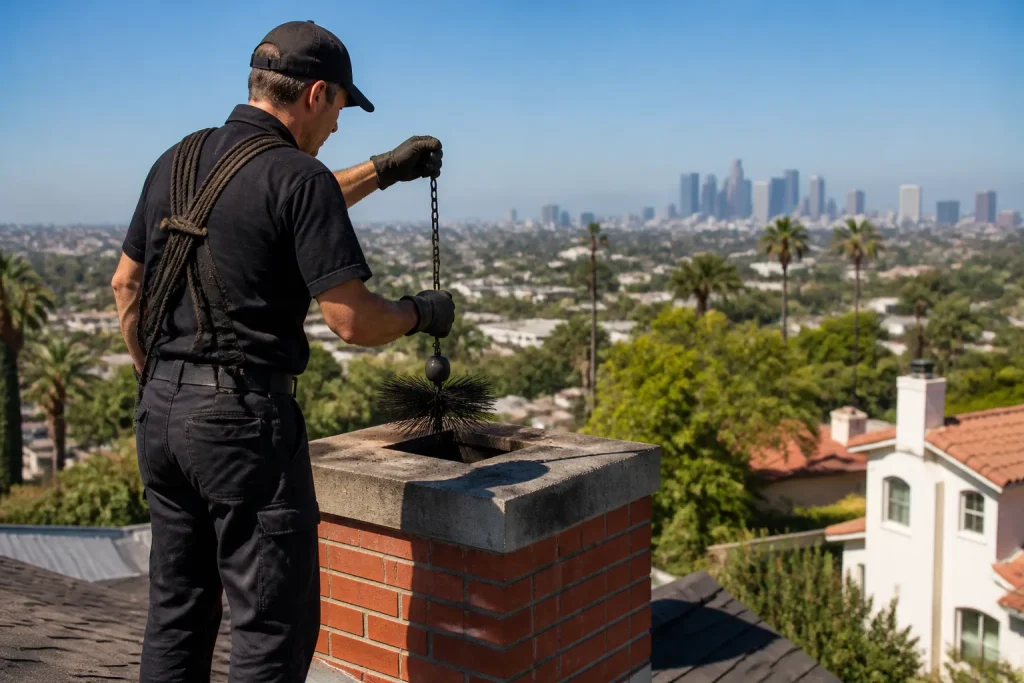
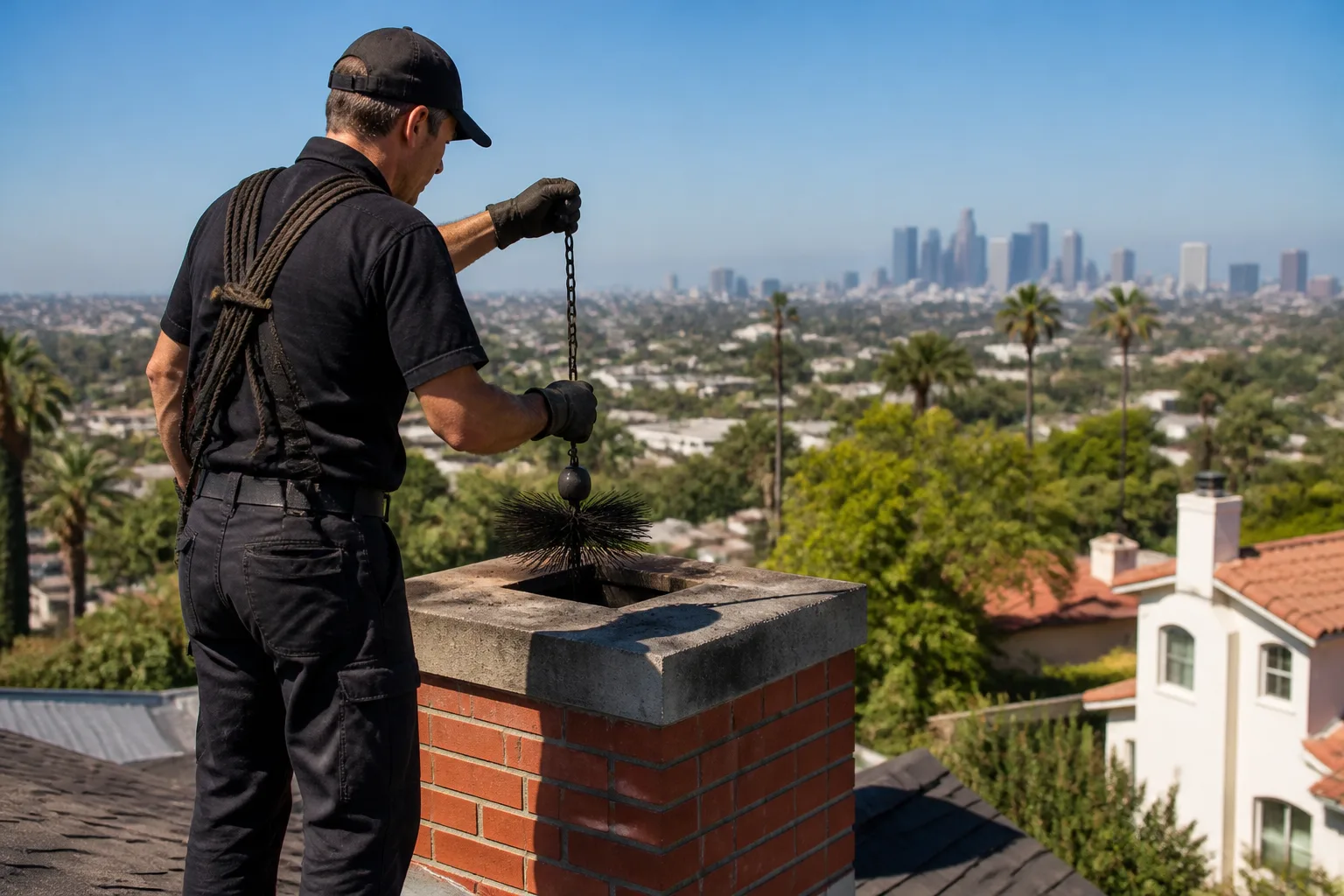
A chimney sweep removes creosote, the tar-like combustion byproduct that builds up inside the flue and causes chimney fires when it ignites. A standard sweep in Los Angeles typically runs $189 to $349 before any repairs, depending on the size of the flue and the level of buildup. The sweep clears the passage. It does not fix cracked tiles. It does not replace a failed liner. It does not repair a crown that’s letting water in.
Sometimes a homeowner calls us for a sweep and what they actually need is a repair that surfaces during the sweep. That’s normal. The sweep is the diagnostic moment. When we brush out the flue and the brush catches on a cracked tile, or when the creosote comes away and reveals spalling underneath, that’s information you need before you decide whether to repair or replace. The sweep is step one. The decision is step two.
In our experience, Los Angeles homeowners generally need a sweep every year if they burn regularly, and every two years if they burn occasionally. Water intrusion from our winter rains accelerates creosote buildup too, because damp creosote hardens into a glaze that’s much harder to remove. If your chimney cap is rusted through, you’re feeding that glaze every time it rains.
When to Call a Pro
If you smell smoke inside the house after the fire is out, call a professional. If you see white staining on the exterior brick, that’s efflorescence, and it means water is moving through the masonry. Call a professional. If you hear a rumble in the chimney that isn’t the wind, or if you see sparks coming out of the top during a fire, that’s a chimney fire in progress. Call 911 first, then call us.
Most of the time, though, the call is simpler: you haven’t had the chimney looked at in years, or you just bought a house and don’t know what’s in there. That’s what we do. We send a background-checked, identity-verified technician to your door, and you’ll know their name and see their photo before they arrive. Every job gets a written price before work begins. Every repair gets a written guarantee. If the repair fails during the coverage period, the second visit is free. That’s the 365-Day Done Right Promise, and it’s how we’ve operated since Ruben Castellano founded the company in 2002.
If you’re in Los Angeles and you need related services, we also handle gas fireplace repair in Los Angeles, including units that won’t ignite or that cycle on and off unexpectedly.
The Bottom Line
The repair-or-replace decision comes down to three variables: where the damage is, how much you use the fireplace, and how old the surrounding masonry is. Get the camera footage. Ask the cost-per-year question. And don’t authorize a replacement without seeing the evidence that justifies it. If you’re in Los Angeles and need help figuring out which path is right for your chimney, Alcott Chimney Sweep offers free estimates. Call (336) 863-3889 and a live person will answer, day or night.
Frequently Asked Questions
A targeted repair like a HeatShield patch on a cracked flue tile typically runs $800 to $1,800 in Los Angeles, while a full flue reline with a system like DuraFlex typically runs $3,200 to $5,500 depending on the flue height and access. Cracked crown repair usually falls between $450 and $950. These are ranges, not quotes, because the flue condition and roof access change the price. For an exact quote with camera evidence, call (336) 863-3889. Estimates are free.
It depends on where the damage sits. Upper-flue cracks are often repairable with targeted resurfacing. Lower-flue damage, especially near the smoke chamber where heat and creosote concentrate, usually points toward a full reline. Ask to see the camera footage and have the technician explain the location and severity of the damage in person. Call (336) 863-3889 for a free evaluation in Los Angeles.
Once a year if you burn regularly, and every two years if you burn occasionally. Los Angeles winter rain accelerates creosote hardening, which makes buildup harder to remove the longer it sits. A standard sweep typically runs $189 to $349 before repairs. Call (336) 863-3889 to schedule in Los Angeles.
Creosote buildup can ignite and cause a chimney fire that reaches 2,000°F, cracking tiles and mortar and potentially spreading to the house. A cracked flue allows combustion gases, including carbon monoxide, to escape into the wall cavity instead of venting out the top. The risk is real and cumulative. The fix is usually straightforward once you know it’s there. Call (336) 863-3889 and we’ll show you exactly what’s happening inside your flue.
Written by Ruben Castellano, Owner at Alcott Chimney Sweep, serving Los Angeles since 2002.
Need Chimney Cleaning Help?
Call Alcott Chimney Sweep - licensed & insured, here with fast after-hours help in Los Angeles.
(336) 863-3889