
DuraFlex Chimney Sweep in Los Angeles: A Homeowner’s Guide
A DuraFlex chimney liner in Los Angeles typically costs between $2,800 and $6,500 installed, depending on chimney height and liner diameter. More importantly, a liner installed to the national minimum spec will technically pass inspection here and may still develop micro-fractures within two years. The reason is simple: Los Angeles chimneys face a combination of seismic movement and thermal cycling that most generic installation guides never account for.
If you’re weighing relining options and want straight answers before you spend a dime, this guide covers what DuraFlex is, what it should cost in the LA market, how to verify your installer is sizing for local conditions, and what a finished job should look like. We’ve been doing this since 2002, and we’d rather you know too much than too little. If you’d rather skip the research and talk to someone directly, call (336) 863-3889 for a free estimate.
Key Takeaways
- DuraFlex is a flexible stainless steel liner system used to reline damaged or unlined chimneys, common in Los Angeles homes built before the 1960s.
- Installation in LA requires sizing for seismic flexibility, not just draft efficiency. Undersized liners crack faster here.
- Real LA pricing runs $2,800 – $6,500 depending on height, diameter, roof access, and whether an insulation wrap is needed.
- Questions to ask any installer: “How are you sizing this for seismic movement?” and “Do you insulate the liner for LA’s condensation conditions?”
- Alcott Chimney Sweep installs DuraFlex systems with written pricing upfront, a written guarantee on every repair, and technicians verified by name and photo before arrival.
What Is DuraFlex, Plainly Explained
DuraFlex is a flexible chimney liner made from stainless steel, manufactured as a corrugated tube that’s pulled through an existing chimney flue. Think of it as a new, continuous pipe inside your old chimney. The material was developed by the same company that supplies professional hearth and chimney trade brands across North America, and it’s specified by chimney pros for homes where the original clay tile liner has cracked, separated, or was never installed in the first place.
The reason DuraFlex matters in Los Angeles specifically is tied to our housing stock. A large share of LA homes built between 1920 and 1960 have masonry chimneys lined with terracotta clay tiles. Those tiles crack over time due to heat stress, moisture, and in our region, the slow grind of seismic movement. When a clay liner fails, the chimney must be relined before it’s safe to use. DuraFlex provides a code-compliant path that doesn’t require tearing apart the chimney from the inside of the house.
We recommend DuraFlex over box-store liner substitutes because of the alloy quality and the way it tolerates flexing. This isn’t a knock on other professional brands. We also work with Olympia Chimney and Copperfield components depending on the specific chimney, and all are trade-grade materials specified by chimney professionals. The key is matching the liner to the application, which matters more than the logo on the box.
The term “DuraFlex chimney sweep” is something we see people search for, and it’s a slight misnomer. You don’t sweep a liner. You install one. But the search intent is usually homeowners in Los Angeles who know their chimney needs relining and want to understand the product before they start taking bids. If that’s you, you’re already ahead of most.
Why LA Chimney Code and Seismic Movement Change the Installation
A DuraFlex liner expands when heated and contracts when cooled. In a stable climate, that cycle happens slowly and predictably. In Los Angeles, two local factors compound the stress on the liner. First, our mild climate means chimneys cool down faster between uses than they do in colder regions, so the thermal cycle is more extreme: hot fire on a 65-degree evening, cooled flue an hour later, repeated all winter. Second, seismic movement, even the small tremors most people don’t notice, flexes the structure around the liner. An undersized or over-rigid liner has nowhere to give, so the stress concentrates at connection points and the liner develops hairline fractures, often at the seam where sections are joined or at the firebox connection.
What does this mean for sizing? The national spec tables give a minimum diameter based on the appliance’s draft requirements. Those tables are a starting point, not a finish line. In Los Angeles, an installer who’s doing the job right should also be checking the existing flue dimensions, the degree of mortar joint erosion, and the clearance between the liner and the surrounding masonry. A properly sized liner has enough flex to absorb movement without tearing, but it can’t be so skinny that heat transfer damages the surrounding structure.
One more local nuance: Los Angeles building code requires a level of moisture resistance in the chimney system that generic guides ignore. Our local air is generally dry, but mornings bring marine layer condensation, and homeowners near the coast deal with salt-air corrosion. That’s why we recommend adding a stainless steel top cap and a rain collar that’s properly sealed. Gel sealants, like Gelco products we stock, are specified for high-temp chimney applications and hold up against the corrosive mix of heat and coastal moisture better than generic silicone from a hardware aisle. If your installer reaches for a caulk gun with a hardware-store tube, ask questions.
What DuraFlex Installation Costs in the Los Angeles Market
Here’s the part every LA homeowner wants: real dollars. We give every customer a written price before any work begins, so we’re not shy about ranges. The table below reflects what we see across the Los Angeles market for DuraFlex installation, including liner, insulation wrap where needed, top cap, and firebox connection. Prices fluctuate with stainless steel costs and roof conditions, but this gives you a benchmark to compare bids.
| Chimney Height | Typical Liner Diameter | Installed Price Range | What’s Included |
|---|---|---|---|
| Under 20 ft (single-story) | 5.5″ – 6″ | $2,800 – $3,800 | Liner, top cap, firebox connection |
| 20 – 35 ft (two-story) | 6″ – 7″ | $3,500 – $5,200 | Liner, insulation wrap, top cap, connection |
| 35+ ft (tall or steep roof) | 6″ – 8″ | $4,800 – $6,500 | Liner, insulation, top cap, connection, roof access |
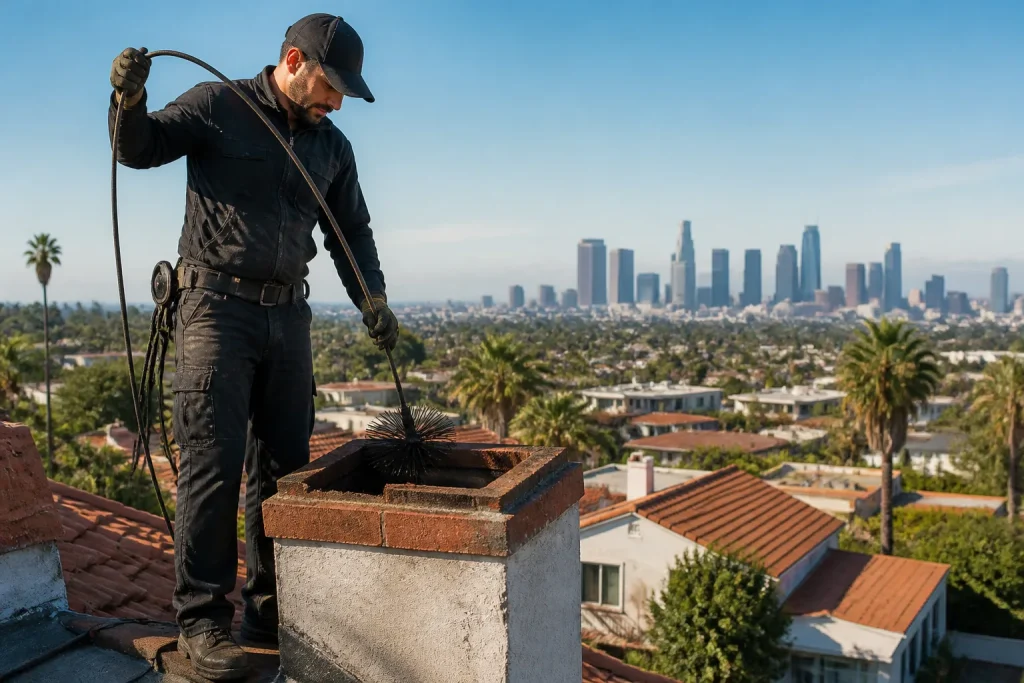
Two things push an LA job toward the top of these ranges. First, roof access. Many Los Angeles homes in neighborhoods like Silver Lake or Echo Park have steep, terraced rooflines, and getting a crew safely anchored while feeding a liner takes more time than a flat suburban roof. Second, whether the old clay tiles need partial removal. If the existing flue is too tight for an insulated liner, portions of the old tile have to be broken out, which adds labor. A good installer will tell you this before starting, not spring it on you as a surprise charge.
We pulled a liner out of a home in Highland Park last month where the previous installer had used a liner one size too small because it was easier to feed through the old flue. It passed inspection at the time, then split along the seam within two seasons. The homeowner had the receipt and the inspection report, and still ended up paying for a second installation. When you’re comparing quotes in Los Angeles, ask every bidder the same question: “Is this sized for seismic movement, or just for draft?”
Questions to Ask Before You Hire a DuraFlex Installer in Los Angeles
You don’t need to become an engineer to protect yourself. You need to ask a few specific questions and watch how the installer responds. The right answers signal that they’re sizing for LA conditions, and the wrong answers tell you they’re running a generic playbook. Here are five questions we’d ask if we were hiring someone else.
- “How are you sizing this liner for seismic movement?” If they stare blankly or say it doesn’t matter, keep looking. A real answer involves assessing flue clearance, mortar condition, and liner diameter in relation to the structure’s flex characteristics.
- “Do you insulate the liner, and when?” Insulation wrap matters in LA because our mild climate creates more condensation cycles than colder cities. An insulated liner also carries a better safety rating in most applications. If they never mention insulation, ask why not.
- “What’s your top cap and rain collar approach?” The top of the liner is where water gets in and where coastal corrosion starts. We use stainless caps and high-temp sealants like Gelco to keep the system tight from day one.
- “Do you provide a written price before starting?” If the answer isn’t an immediate yes, that’s a red flag. No homeowner in Los Angeles should agree to an open-ended chimney project.
- “Can you show me a photo of the liner sitting in the flue after installation?” We photograph every liner before we set the top cap, and we include the photos in our report. An installer who won’t show you the work probably didn’t do the work they’re charging for.
We also recommend asking for the technician’s name before the appointment and confirming they’ll show identification at the door. Every Alcott technician is background-checked and identity-verified through the Threshold Standard, which is the vetting process used across the Threshold Group family of home-service companies, and we’d like to see more of the industry adopt it. You’ll know your technician’s name and see their photo before we arrive. This shouldn’t be a luxury in Los Angeles; it should be the baseline.
When to call a pro: If you see cracked tiles, rust stains, water in the firebox, or smoke backing into the room, don’t wait. Those are failure signals, not quirks. A deteriorating liner can allow heat and gases to reach combustible framing, and a cracked liner is exactly the condition that leads to chimney fires. This isn’t a project to approach as a weekend experiment. The materials require professional installation, and the safety stakes are too high to get wrong. Chimney sweeps in Los Angeles who inspect before relining are doing it right, because you can’t properly size a liner for a flue you haven’t examined.
What a Properly Completed DuraFlex Installation Should Look Like
After your installer leaves, you should be able to verify the work yourself, visually, without special tools. Here’s what we tell homeowners to check. At the top of the chimney, the liner should extend above the chimney crown and sit inside a properly fitted stainless steel top cap. The cap should cover the opening completely, with no gaps at the edges where rain could enter. The rain collar should seat tight against the liner and the cap, and the high-temp sealant around the base should be applied cleanly, no globbed-on caulk, no visible cracks in the seal.
At the firebox connection, the transition from the liner to the appliance should be smooth and attached with a proper connector, not improvised with sheet metal screws or foil tape. We’ve seen liners that weren’t connected to the appliance at all, just sitting in the flue above the firebox, which is worse than useless. It creates a gap where heat and gases pool inside the chimney chase. A proper connection is mechanically attached and verified with a draft test before the job is signed off.
Inside the flue, a camera inspection should show the liner running in one continuous length from firebox to cap with no kinks, no twists that would restrict flow, and no visible sagging. If the installer says the liner is “good enough” but won’t show you the camera footage, hold payment until you see it. We include camera inspection and a photo report with every liner installation in Los Angeles, because no homeowner should take “trust me” as a receipt.
Related services in Los Angeles: If you’re considering a liner because an inspection flagged damage, make sure the inspection was thorough. Chimney inspections in Los Angeles should include camera work, not just a flashlight glance from the roof. We also handle gas fireplace repair in Los Angeles for homeowners switching from wood to gas, which often changes the liner sizing requirements entirely.
The Bottom Line
DuraFlex is a proven professional liner system, but in Los Angeles, the install matters more than the brand name on the box. Size it for seismic movement, not just draft. Insulate it for our condensation conditions. Seal the top properly, connect the firebox correctly, and verify the work with photos before you pay. Skimping on any of those steps turns a $3,500 liner into a $6,000 do-over.
If you’re in Los Angeles and want a DuraFlex liner sized for this city’s specific conditions, Alcott Chimney Sweep offers free estimates and written pricing before any work starts. We install DuraFlex liner systems with a written guarantee on every repair; if the repair fails within the coverage period, the second visit is free. That’s our 365-Day Done Right Promise, and it applies to every completed job. Call (336) 863-3889 to schedule an assessment. A live person answers every call, around the clock.
Frequently Asked Questions
Expect to pay $2,800 – $6,500 for a DuraFlex liner installed in Los Angeles, depending on chimney height, liner diameter, roof access, and whether insulation wrap is required. Single-story homes generally fall at the lower end, while tall or steep-roof chimneys trend toward the top. Call (336) 863-3889 for an exact quote, estimates are free.
A properly sized and installed DuraFlex liner typically lasts 20 – 25 years in Los Angeles conditions. Undersized liners or poorly sealed top caps shorten that lifespan significantly, sometimes to under five years. The failure points to watch are the seam connections and the firebox transition, both spots where flex stress concentrates during seismic movement.
Clay tile liners cannot be patched effectively. Once tiles crack or separate, the flue is no longer safe to use, and the standard remedy is relining with a stainless steel system like DuraFlex. HeatShield resurfacing can address certain minor gaps, but significant structural damage requires a liner. A camera inspection will tell you which path is open.
We don’t recommend it. Working on a chimney involves roof access, high-temperature materials, and fire-safety connections that require trained hands. Incorrect installation creates a fire and carbon monoxide risk. We’d rather see you hire a licensed professional and verify the work with photos than risk a partial job done on a ladder.
Written by Ruben Castellano, Owner at Alcott Chimney Sweep, serving Los Angeles since 2002.
Need Chimney Cleaning Help?
Call Alcott Chimney Sweep - licensed & insured, here with fast after-hours help in Los Angeles.
(336) 863-3889